
AI-Augmented Application Portfolio Management
Organizations want to do application portfolio management. They should, and they should do it with Sparx EA. Sparx Systems makes that case, and we agree. You no longer need to key the portfolio into the repository by hand and chase it every quarter. We teach your portfolio architects the modern way, or we build it for you.
The modern way to do APM
The data a portfolio needs already lives in your project and portfolio management (PPM), IT service management (ITSM), governance, risk and compliance (eGRC) and IT financial management (ITFM) systems. The old way copies it into the repository. The modern way connects to it, so there is less effort, the data stays in the source systems, and portfolio analysis runs on live data: the answer to “what should we consolidate?” reflects today, not last quarter.
- Record static values into the repository, one application at a time
- Maintain spreadsheets that go stale between reviews
- Re-collect the data every quarter to bring the portfolio back up to date
- Present a portfolio view that was already out of date when it was built
- Use AI to connect to your PPM, ITSM, eGRC and ITFM systems
- Let the architecture model stitch the data together and show the relationships between applications, capabilities, costs, risks and projects
- Build the portfolio dashboards in Prolaborate or Power BI
- The architect reviews what the AI connected and makes the call
Where AI lands in portfolio work
Build the portfolio as a model
Applications as properly stereotyped components in your MDG, related to the capabilities, projects and services around them.
AnalysisRationalize with evidence
Redundancy and consolidation candidates with the evidence behind them, and "what breaks if we retire this?" answered from the real dependency graph. The model ties together what the PPM, ITSM, eGRC and ITFM systems hold.
GovernanceKeep the data trustworthy
Checks for missing owners, lifecycle and criticality, so decisions rest on complete, consistent data.
Stakeholder EngagementBrief leadership from the model
Investment-planning views, such as criticality against health and consolidation shortlists, in language a sponsor reads without a diagram tutorial.
What a portfolio architect can now get done
With AI-Augmented Architecture, a portfolio architect says which questions the portfolio must answer and which system holds each fact, gives the instructions in a prompt, and reviews the portfolio model that comes back.


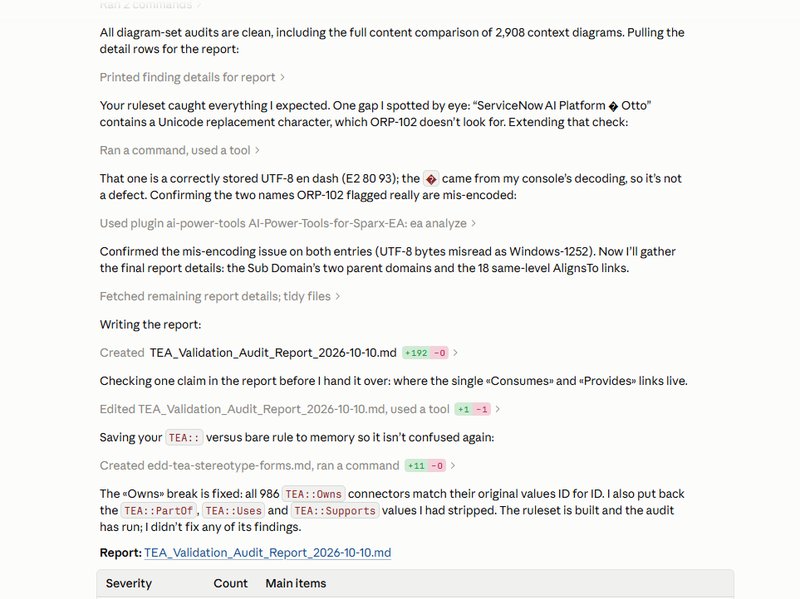

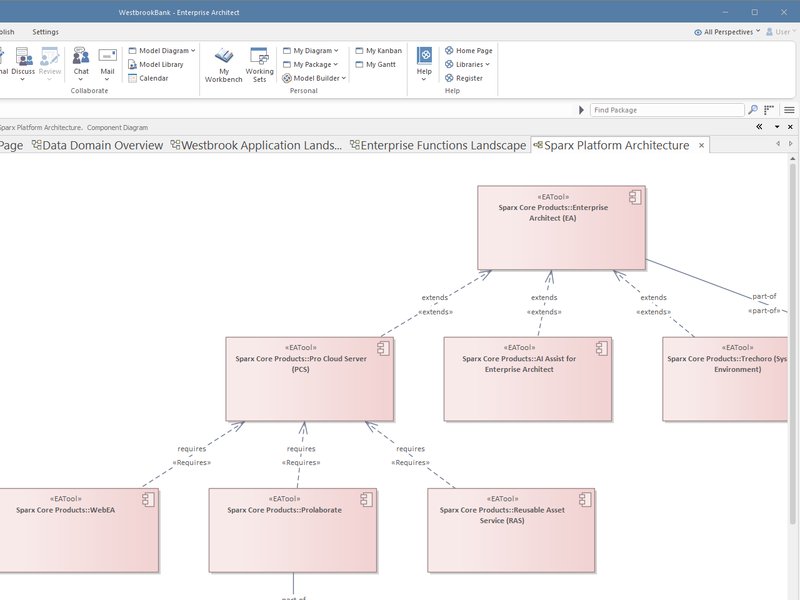

Connecting the portfolio to the systems that hold the data
Today an architect keys status, cost and risk values into the repository application by application, and chases the owners of the PPM, ITSM, eGRC and ITFM systems for fresh exports each quarter. AI-augmented, the architect says which questions the portfolio must answer and which system is the source of record for each fact, and AI connects to those systems and brings the values in.
The skill is knowing the portfolio questions well enough to name the source for each one, and describing the connection precisely.
Letting the model stitch the data together
Today, relating an application to its project, its risks and its run cost means opening several spreadsheets and matching names by eye. AI-augmented, the architect states the matching rules, such as what makes a project record belong to an application and what to do when it matches two, and AI relates the records in the model. One application then shows its owner, project, open risks and cost together.
The skill is writing matching rules that reflect how your organization actually names things, and checking the exceptions.
Finding the applications that overlap
Today, redundancy is found in a workshop with a spreadsheet, and the evidence is a list of opinions. AI-augmented, the architect frames the overlap question (same capability, similar function, different cost or health), asks the model, and gets candidates back with the evidence behind each.
The skill is asking a precise question and judging the answer, including which apparent duplicates serve regulated work that must stay separate.
Saying what breaks if an application is retired
Today someone asks around the integration and operations teams and hopes nobody was forgotten. AI-augmented, the architect asks the model for everything that relies on the application (services, integrations, processes, projects) and reads the list with its evidence.
The skill is knowing what a complete answer should contain, and noticing what the model has no way of knowing.
Keeping the portfolio data complete
Today a data quality pass is a spreadsheet exercise the week before the quarterly report. AI-augmented, the architect states the portfolio standard as rules, such as an owner, a lifecycle stage and a criticality rating on every application. AI checks every application and lists the gaps for the people who can fill them.
The skill is stating the standard in rules specific enough to run, then deciding what each finding means.
Giving leadership a dashboard that stays current
Today the portfolio slides are rebuilt each quarter from the spreadsheet and are out of date by the meeting. AI-augmented, the architect starts from the decision a leader has to make, such as what to consolidate, and describes the view that would inform it. AI builds it in Prolaborate or Power BI on the connected data.
The skill is starting from the leader's decision, and describing the view in terms of that decision.
Which tools help with this work, and when
The right tool depends on the job and on where the people who need the answers already work. For stakeholders it is usually the tool they already have open.
- Claude + AI Power Tools
The widest range of guided portfolio work: connecting the source systems, relating the records in the model, checking the data for gaps and building the views, on the live repository.
- GitHub Copilot + AI Power Tools
The same work from VS Code, for architects who already work there.
- Kernaro Assist
Works inside Enterprise Architect as architects model, checking the portfolio data, so a missing owner, lifecycle stage or criticality rating shows as it is entered.
- Kernaro AI Hub
Answers the overlap and “what breaks if we retire this?” questions across the whole portfolio.
- Prolaborate 6 with AI
Gives leadership portfolio views in a browser, with no EA modeling skills needed.
- Power BI
Dashboards for leadership, in a tool they already open. Kernaro AI Hub is the recommended feed for anyone who can afford it, read live through the Kernaro Connector for Power BI.
- Microsoft 365 Copilot
Read-only. Leadership can ask which applications overlap in Teams or Outlook, answered from a published Power BI model or, with Kernaro AI Hub, through its read-only API.
AI can take on tasks. The architect owns the portfolio.
The architect still owns the decision
AI can tell you three applications look redundant. It cannot tell you that two of them serve regulated workloads that must stay separate, or that the "duplicate" is the one keeping a critical integration alive. It can trace every dependency it finds in the model, but if a dependency was never captured, it won't warn you it's missing.
Closing that gap is the architect’s job. The architect translates between what the business needs and what the IT estate does, makes the consolidation decision and owns the consequences.
How we help
Train and mentor your architects
Training and mentoring that teach your portfolio architects to connect the source systems, let the model show the relationships and keep the portfolio current, on your own repository, then stay with them until the new habits stick.
For ArchitectsBuild the model for you
Consulting for organizations that are capacity constrained or need results quickly. We build the portfolio model in your repository, connected to your source systems, and hand it over complete and current.
Build the model for youGet your EA data into the tools leaders use
With AI we set up the portfolio dashboards in Prolaborate or Power BI on the connected data, so the leadership view stays current.
Reporting and Power BI
Frequently asked questions
Does AI replace the architect in portfolio management?
No. AI scales the data work: connecting source systems, surfacing redundancy candidates, tracing dependencies across the whole portfolio. The architect still decides what is genuinely redundant, what is safe to consolidate, and what the business can tolerate.
What does the portfolio need before this works?
A governed Sparx EA repository where applications carry consistent metadata and relationships. Ungoverned data produces fast, confident, wrong answers. We assess whether your repository is ready as part of the engagement and remediate the data foundation as needed.