
AI-Augmented Enterprise Architecture
Leaders keep asking enterprise architects for more: which capabilities need investment, what a strategy touches, what a change puts at risk. The answers are in the model when the model is complete and current. We help your architects get it there and keep it there with AI, on your live Sparx EA repository and in your own MDG.
Build the enterprise picture once, then keep it current
An enterprise architect's value is the connected picture: capabilities, value streams, applications and strategy, related well enough that leadership can act on it. Much of the effort goes into assembling that picture from inventories, strategy documents and interviews.
- Capability maps, value streams and application inventories are rebuilt from workshops, spreadsheets and slide decks
- Strategy-to-execution links, from objective to capability to initiative to application, are drawn one chain at a time
- A question such as "which initiatives touch this capability?" waits for someone to assemble the answer
- The model reflects the last time someone had a free week to update it
- AI loads capability, value stream and application data from the inventories you already hold, typed to your MDG
- The model carries objective, capability, initiative and application as linked elements, so the chain can be queried
- The architect asks the model the question and reviews the evidence it returns
- The architect decides what the model should say about the enterprise; AI keeps it complete
Where AI lands in enterprise architecture work
These are the four use cases behind AI-Augmented Architecture, applied to an enterprise architecture practice.
Reverse-engineer current state
Turn spreadsheets, inventories, and source documents into properly stereotyped, connected elements in your repository. Current state is captured as model data, in your MDG, rather than transcribed by hand.
AnalysisAnalyze at enterprise scale
Run relationship discovery, impact tracing, dependency health, and cross-domain queries across the whole repository, not the few facets a manual pass has time for. The model ties in the strategy documents, spreadsheets and operational systems around the repository.
GovernanceMove standards to enforced
Check the repository for completeness against your MDG standards: untyped elements, missing owners, inconsistent stereotypes and tags. Every downstream AI interaction then rests on data that is complete and consistent.
Stakeholder EngagementMake architecture reach the enterprise
Turn the model into business-readable outputs and answer common architecture queries without an architect in the loop. Stakeholders pull architecture context into their decisions directly, in language they read without a diagram tutorial.
What an enterprise architect can now get done
With AI-Augmented Architecture, an enterprise architect hands over the inventories, strategy documents and interview notes, gives the instructions in a prompt, and reviews the enterprise model that comes back.
In Ryan Schmierer's experience, half an enterprise architect's week goes to gathering and transcribing data. That is the time available for the work leadership wants from the function.







Building the current-state picture
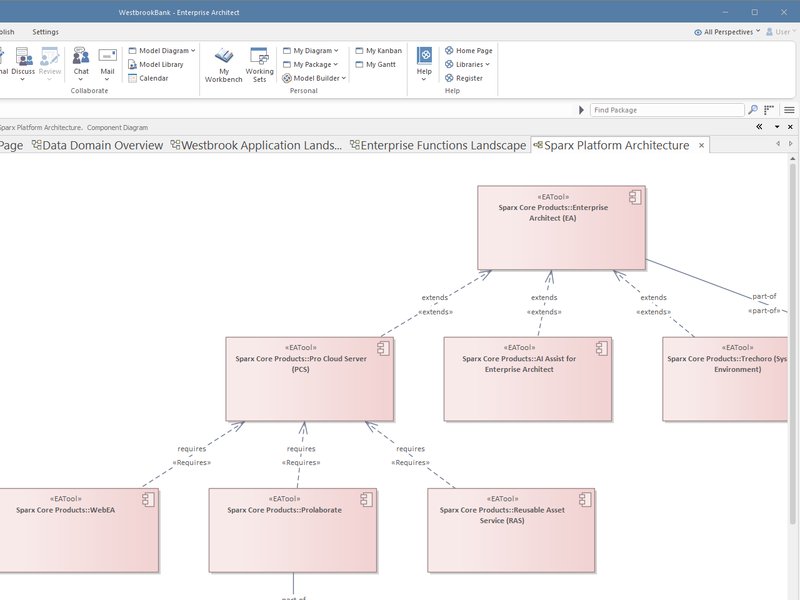
Today capability maps, value streams and application lists are rebuilt by typing from spreadsheets, slides and documents. AI-augmented, the architect decides how the enterprise should be described (which capability levels, which attributes, which MDG types) and hands AI the source material. AI creates connected, correctly typed elements in the repository.
The skill is choosing the structure and granularity, and stating them precisely enough that the model comes out consistent.
Finding your way around the model
Today an architect draws navigation diagrams by hand and they go stale as the model changes. The AI-augmented way starts with the people who will use them: what experience do you want a stakeholder to have when they open the model, where should they land, how should they drill down? You express that intent, and AI builds the navigation diagrams and keeps them current.
The skill is designing the experience and stating the intent clearly; the drawing is no longer the architect's job.
Tracing a strategy through to the applications that deliver it
Today the chain from objective to capability to initiative to application is drawn link by link, in workshops. AI-augmented, the architect states the chains leaders reason along and asks the model which initiatives touch a capability. AI proposes the links and returns the answer with its evidence.
The skill is knowing which chains matter, and telling a real gap from a missing record.
Holding the repository to your standard
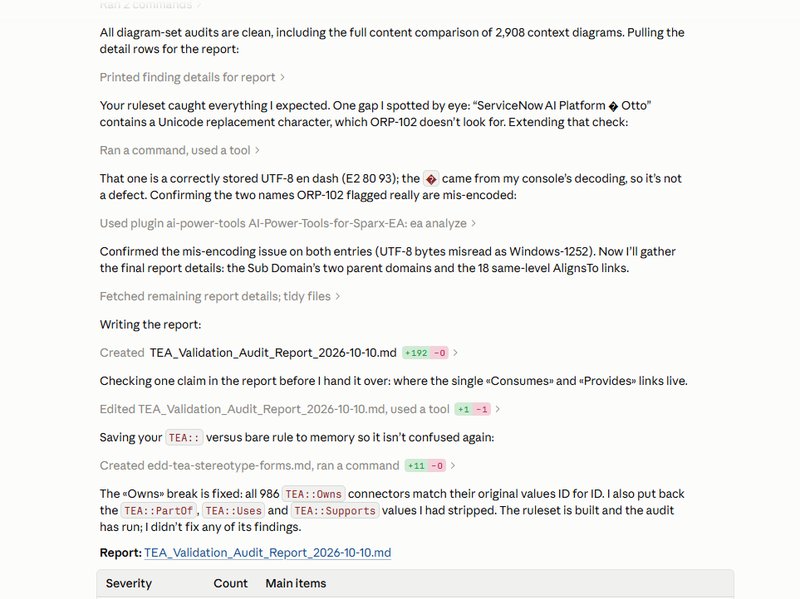
Today the standard lives in a document and is enforced by reviewing diagrams by eye. AI-augmented, the architect expresses the standard as rules (typed elements, an owner on every application, consistent tags). AI checks the whole repository, fixes the mechanical gaps and reports the rest.
The skill is turning a standard into rules specific enough to check, and deciding which findings are exceptions.
Answering a leader's question without an architect in the room
Today a leader's question goes to an architect, who builds a slide. AI-augmented, the architect anticipates the questions leaders will ask and sets up views and plain-language answers they can reach without a Sparx EA license.
The skill is understanding the leader's questions well enough to design the answers, and stating what each answer can and cannot claim.
Updating the model for what the projects delivered
Today updates wait for someone to have a free week, and depend on memory of what changed. AI-augmented, the architect points AI at what the project teams delivered, such as design documents and change records, and reviews the proposed updates against the last baseline.
The skill is directing the update clearly and judging which changes are real.
Which tools help with this work, and when
The right tool depends on the job and on where the people who need the answers already work. For stakeholders it is usually the tool they already have open.
- Claude + AI Power Tools
The widest range of guided enterprise architecture work: building the current-state picture, finding the way around the model, holding the repository to the standard and updating it for what the projects delivered, on the live repository.
- GitHub Copilot + AI Power Tools
The same work from VS Code, for architects who already work there.
- Kernaro Assist
Works inside Enterprise Architect as architects model, checking the repository against your MDG standard, such as untyped elements, missing owners and inconsistent tags.
- Kernaro AI Hub
Answers the strategy-to-application and investment questions across the whole repository.
- Prolaborate 6 with AI
Gives leaders capability and strategy views in a browser, with no EA modeling skills needed.
- Power BI
Dashboards for leaders, in a tool they already open. Kernaro AI Hub is the recommended feed for anyone who can afford it, read live through the Kernaro Connector for Power BI.
- Microsoft 365 Copilot
Read-only. Leaders can ask where to invest or what a change touches in Teams or Outlook, answered from a published Power BI model or, with Kernaro AI Hub, through its read-only API.
AI can take on tasks. The architect owns the enterprise architecture.
The architect still owns the decision
AI can confirm that an element has its required tagged values, that a relationship type is valid, that nothing is missing against your standards. It cannot tell you whether the model is right: whether the architecture reflects reality, whether the decision it implies is sound, whether the dependency it found matters.
The lasting work of enterprise architecture is translating between business and IT, and knowing which pieces to set aside and which decision the model is there to support. AI handles the production. It does not supply the discipline.
Pointing AI at your repository does not make the practice good at AI-Augmented Architecture, any more than installing Sparx EA makes someone an architect.
How we help
Train and mentor your architects
Training and mentoring that teach your architects to build the enterprise picture, keep it current and hold it to your standard, on your own repository, then stay with them until the new habits stick.
For ArchitectsBuild the model for you
Consulting for organizations that are capacity constrained or need results quickly. We build the current-state model in your repository from your inventories and strategy documents, and hand it over complete and current.
Build the model for you
Frequently asked questions
Does AI replace the enterprise architect?
No. AI scales the data work: checking completeness against your standards, tracing dependencies, and turning the model into business-readable outputs at enterprise scale. The architect still decides whether the architecture reflects reality and which decision the model is really there to support.
What does the repository need before this works?
A governed Sparx EA repository where elements carry consistent stereotypes, tagged values, and relationships under your MDG. Pointed at an ungoverned repository, AI produces confidently wrong answers at executive speed. We assess whether your repository is ready as part of the engagement and remediate the governance foundation as needed.